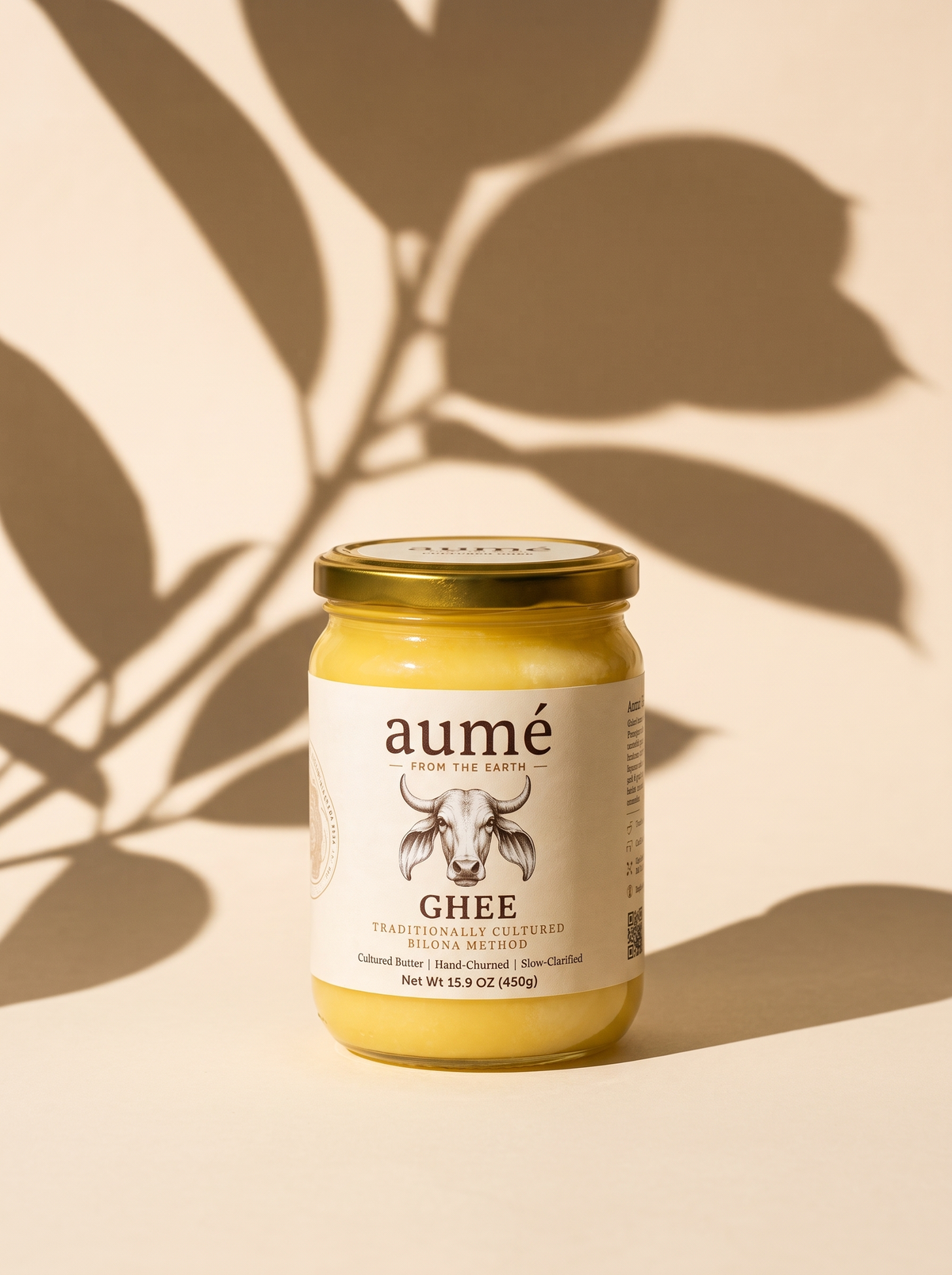
You can taste the difference between amethod and a shortcut.

A2 Gir cow milk. Cultured overnight. Churned slowly by bilona. Clarified over open flame. One ingredient. No shortcuts.

Buy now — 250g jar, $24.99
Skip to product information
1 of 1

N° 02 · GIR REGION · GUJARAT

A2 Gir Cow Bilona Ghee

A2 Gir Cow Bilona Ghee

Hand-churned from the cultured milk of indigenous Gir cows using the ancient bilona method. One ingredient. Five thousand years of craft. Zero shortcuts.

Regular price $24.99 USD
Regular price Sale price $24.99 USD
Sale 2026 Harvest Coming Soon
/ 250g 8.8 oz
Shipping calculated at checkout.
Size

Auto-renews, skip or cancel anytime. View subscription policy

Auto-renews, skip or cancel anytime. View subscription policy

To add to cart, go to the product page and select a purchase option

Free US shipping on every order · Ships in 1–2 business days from New Jersey · Independently lab tested

Independently lab tested

Our A2 Gir cow bilona ghee is independently lab tested by Eurochem Laboratories for purity, adulteration, microbial safety and shelf life, so you know it's pure cultured ghee with nothing blended in.

A2 Gir Cow Ghee Purity & Adulteration Lab Report (PDF)

Bilona Ghee Lab Test Report & Nutrition Facts (PDF)

Cultured Ghee 12 Month Shelf Life Study (PDF)

All A2 Bilona Ghee Certificates of Analysis →

Questions, answered

What does bilona mean?

Bilona is the traditional way of making ghee. Whole milk is cultured overnight into curd, the curd is churned slowly with a wooden churner until butter separates, and that butter is clarified over an open flame. Most ghee sold today skips the culturing and churning and is made directly from cream.

What is A2 ghee?

A2 refers to the type of beta casein protein in the milk. Indigenous Indian breeds like the Gir cow produce milk with A2 beta casein rather than the A1 type found in most commercial dairy. Our ghee is made only from Gir cow milk, from one region, so it is A2 throughout.

Why is cultured ghee different?

Culturing the milk into curd before churning develops the deep, nutty aroma and slightly tangy finish that cultured ghee is known for. Ghee made straight from cream is flatter in flavour. You can tell the difference the moment you open the jar.

Does it need to be refrigerated?

No. Keep it at room temperature with the lid on, away from direct sunlight, and always use a clean, dry spoon. Independent shelf life testing shows it keeps for 12 months from the date of manufacture.

Why is the texture grainy?

Ghee that cools slowly forms small crystals, which gives cultured ghee its sandy, grainy texture. Factory ghee is cooled fast to keep it smooth. The grain is a sign of the slow process, not a fault, and it melts identically. In summer it may soften or go liquid; in winter it firms up. Both are normal.

Is it suitable if I avoid lactose?

Clarification removes almost all of the milk solids, so ghee contains only trace lactose and casein and many people who avoid lactose use it comfortably. It is still a dairy product. If you have a milk allergy, please check with your doctor first.

What can I cook with it?

Almost anything. Its smoke point is around 250°C (485°F), so it is ideal for searing, roasting and sautéing, and it works on toast, in rice and dal, in coffee, and in baking as a one for one replacement for butter. See our how to use ghee page for ideas.

How do I know it isn't adulterated?

Every batch is tested by an independent laboratory for milk fat content, adulteration markers such as Reichert Meissl and Polenske values, and microbial safety. We publish the reports. You can read them on our certificates of analysis page.

Where is it made and where does it ship from?

The ghee is made in the Gir region of Gujarat, India, and packed in glass. Orders ship from our facility in New Jersey within 1 to 2 business days. US shipping is free on every order.

Which size should I choose?

The 250g jar suits occasional use or a first try. The 450g jar is the better value per gram and lasts a household that cooks with ghee most days around a month or two. Both keep for 12 months, so there is no rush to finish.

View full details

From the cowto the jar.

Five steps, unchanged for generations. There is no faster way to make bilona ghee. Any shortcut produces something different.

485°F SMOKE POINT

485°F SMOKE POINT

Holds through a hard sear

OPEN FLAME

OPEN FLAME

Slow clarification

Nutty Aroma

Nutty Aroma

Built by the flame alone

CULTURED CURD

CULTURED CURD

Overnight ferment

Cold Churned

Cold Churned

Slow churned, never overheated

made equal. Not all ghee is

Most commercial ghee is made from A1 crossbred cow milk, processed in industrial dairies, and clarified at speed using centrifuges. Bilona ghee begins somewhere different: with a single indigenous breed, whose milk carries the A2 beta-casein protein structurally distinct from the A1 protein found in most commercial dairy. After culturing the milk overnight, it is churned using the bilona method a wooden churner rotated in alternating directions. The butter is then slow-cooked over open flame until the milk solids separate and fall, leaving a clarified ghee with a nutty, complex aroma that no industrial process replicates. One ingredient. No additives.

Slow Cooked Over Flame

Simmered until the milk solids separate and fall. One ingredient, no additives

Bilona Churned Method

A wooden churner rotated slowly in alternating directions.

Cultured Overnight

Set into curd and left to culture through the night before it ever reaches the churn

Single A2 Breed

Milk from one indigenous breed, carrying the A2 protein, never A1 crossbred herds

Complete the ritualwith Himalayan Honey.

Our honey is between harvests. Join the waitlist and be first in line for the 2026 batch.

$44.99
/ 12 oz · 340g
Front and back of Aumé raw Himalayan clear honey jars showing label and nutrition facts, with honey dipper and dried flowers